 Posted by
 Lauterbrunnen is one of the most famous valleys in the Bernese Oberland. Steep cliffs, waterfalls, and easy access to car-free mountain villages make it a top base for tourists. The best part: you do not need a car. Lauterbrunnen is connected to the Swiss public transport network by train and bus, and the connections are usually smooth, frequent, and well coordinated.
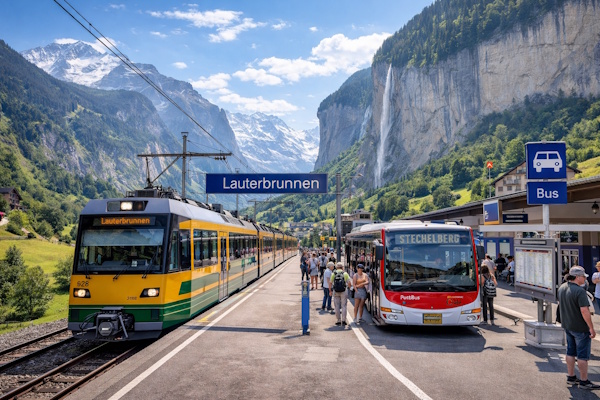
In this guide you will learn how the train and bus system in Lauterbrunnen works, how to arrive from major Swiss hubs, how to reach nearby villages like Wengen and Mürren, and how to use buses inside the valley for sightseeing (for example the waterfalls). This is a practical planning article for tourists, written in simple English.
Why Lauterbrunnen Is a Perfect Destination Without a Car
Many travelers assume that mountain regions require a rental car. In the Bernese Oberland this is often not true. The region has one of the best public transport systems in Europe, and Lauterbrunnen is a great example. The valley has a train station with direct connections to Interlaken, and local buses cover the main valley road to Stechelberg.
- No parking stress: parking can be limited and expensive in peak season.
- Direct access to mountain railways: trains and cable cars are connected like one system.
- Flexible day trips: you can move fast between valleys and villages.
- Great for families: short transfers, easy navigation.
- More relaxing: you can focus on the scenery instead of driving narrow roads.
If you plan to explore the wider region, you can also use Lauterbrunnen as a base for day excursions. See also: Day trips in Switzerland.
Train Travel to Lauterbrunnen
Lauterbrunnen has a small but very important station at the end of the valley line. Most tourists arrive via Interlaken Ost, which is the main transport hub of the region.
Interlaken Ost to Lauterbrunnen (the main route)
The most common connection is the regional train from Interlaken Ost to Lauterbrunnen. This is easy and typically requires no planning beyond checking the next departure time.
- Start: Interlaken Ost
- Destination: Lauterbrunnen
- Travel time: around 20 minutes
- Frequency: usually every 30 minutes (more often in peak periods)
The ride is scenic and gives you a first impression of the valley landscape. It is also the route you will use if you stay in Interlaken and visit Lauterbrunnen for a day. (Interlaken is explained here: Interlaken travel guide.)
Arriving from Zurich
If you arrive in Switzerland via Zurich Airport or Zurich main station, the typical route is Zurich → Bern or Zurich → Lucerne → Interlaken Ost → Lauterbrunnen. Interlaken Ost is your key transfer point. From there, take the regional train straight into the valley.
Arriving from Basel
From Basel (including Basel SBB, where many international trains arrive), the usual route is Basel → Bern → Interlaken Ost → Lauterbrunnen. This route is popular for travelers coming from Germany or France.
Arriving from Bern
Bern is very well connected and often the simplest transfer city. From Bern you can reach Interlaken Ost quickly, and then continue to Lauterbrunnen. If you want to visit the Swiss capital, see: Trip to Bern and Zytglogge clock tower.
What Happens at Zweilütschinen (Important for Grindelwald Connections)
On the route from Interlaken into the mountains, the railway line splits at a small station called Zweilütschinen. One branch goes to Lauterbrunnen, the other to Grindelwald. For many tourists this is relevant because it explains why some trains or platforms show both destinations.
If you plan a day that includes both valleys (for example Grindelwald in the morning and Lauterbrunnen in the afternoon), you will typically travel via Interlaken Ost or via the branch connection depending on the timetable.
Getting from Lauterbrunnen to Wengen (Train)
Wengen is one of the most famous villages in the Bernese Oberland. It is car-free and can only be reached by train or on foot. The connection starts directly at Lauterbrunnen station.
- Route: Lauterbrunnen → Wengen (Wengernalpbahn)
- Travel time: around 12–15 minutes
- Frequency: very regular, designed for tourists and locals
Wengen itself is also a viewpoint terrace over the valley and is perfect for relaxed sightseeing without needing a long hike.
Getting from Lauterbrunnen to Mürren (Cable car + mountain train)
Mürren is another car-free village, located on a sunny terrace above the Lauterbrunnen valley. The most common public transport route is:
- From Lauterbrunnen: short transfer to the cable car (depending on your route)
- Cable car up to Grütschalp (or via Stechelberg/Schilthorn route)
- Mountain train from Grütschalp to Mürren
Mürren is a top base for panoramic walks and also the main access area for the Schilthorn.
For a broader overview of mountain transport in the region, see: Cable cars in the Bernese Oberland and Cog railways in Switzerland.
Buses in Lauterbrunnen Valley (Local Transport)
Inside the valley, the most useful public transport is the bus line from Lauterbrunnen to Stechelberg. The bus runs along the valley floor and stops at important points for sightseeing and hiking.
Main bus route: Lauterbrunnen → Stechelberg
- Start: Lauterbrunnen station / village area
- End: Stechelberg (valley end)
- Travel time: around 20 minutes
- Use case: valley sightseeing, hiking access, cable car stations
This bus is extremely practical if you do not want to walk long distances on the valley road. It also helps you build “one-way” walking routes: you can take the bus to one end and walk back, or walk one direction and return by bus.
Bus stop for Trümmelbach Falls
The bus stops close to Trümmelbach Falls, one of the most unique waterfall attractions in Switzerland. These falls run inside the mountain, shaped by glacial meltwater. For many tourists, the best method is simple: take the bus from Lauterbrunnen, visit the falls, then continue further into the valley or return.
Staubbach Falls: usually a short walk
Staubbach Falls is located close to the village. Most visitors walk there from the station area, because it is quick and easy. The viewpoint is a classic Lauterbrunnen photo spot.
Tickets and How to Pay for Trains and Buses
In Switzerland, the public transport system is integrated. In many cases you can buy a ticket that covers trains and buses together, depending on your route. The easiest way for tourists is to use the SBB app or ticket machines at stations.
Best options for tourists
- Single tickets: good if you only do one or two rides.
- Day passes / regional passes: useful if you do many trips in one day.
- Swiss Travel Pass: can be worth it if you travel across Switzerland for several days.
- Half Fare Card: popular for longer stays, but depends on your travel style.
Important: many mountain railways and cable cars are not fully included in standard train tickets. For example, trips to very high places like Jungfraujoch are usually separate and expensive. If that excursion is part of your plan, it is smart to check the ticket options early.
Jungfraujoch tickets and tours (popular day trip from Interlaken)
If you plan to combine mountain transport with a flagship excursion, Jungfraujoch is the best-known option. Booking online can be useful in peak season.
Typical Tourist Routes Using Trains and Buses
To make planning easier, here are realistic routes that many tourists do. They are simple, logical and work well without a car.
Route 1: Interlaken → Lauterbrunnen (half-day trip)
- Train from Interlaken to Lauterbrunnen
- Walk to Staubbach Falls
- Optional: bus to Trümmelbach Falls
- Return by train
Route 2: Lauterbrunnen → Stechelberg (valley sightseeing day)
- Bus from Lauterbrunnen to Stechelberg
- Stop at Trümmelbach Falls
- Short walks along the valley floor
- Return by bus
Route 3: Lauterbrunnen → Wengen (easy mountain village visit)
- Train to Wengen
- Walk through the village for panoramic views
- Return to Lauterbrunnen by train
Route 4: Lauterbrunnen → Mürren → Schilthorn (viewpoint day)
- Public transport to Mürren
- Continue to Schilthorn for the panorama
- Return via the same route
Route 5: Lauterbrunnen → Kleine Scheidegg → Jungfraujoch (full-day flagship route)
- Train to Wengen
- Continue by cog railway to Kleine Scheidegg
- Optional: continue to Jungfraujoch
Practical Tips (What Tourists Often Get Wrong)
- Not starting early: in summer, popular routes get busy. Early departures help.
- Ignoring the weather: high viewpoints can be cloudy even if the valley looks sunny.
- Doing too much in one day: it is better to combine one mountain highlight with valley sightseeing.
- Not using the bus: the valley bus saves time and energy, especially for waterfalls.
- Forgetting winter conditions: schedules and walking conditions can change outside summer season.
If you want a broader view of what to do in the region, see: Where to go in Switzerland and Sights in Switzerland.
FAQ: Lauterbrunnen Trains and Buses
Is there a direct train from Zurich Airport to Lauterbrunnen?
Usually not direct. Most routes include at least one change (often in Bern or Interlaken Ost). The final section from Interlaken Ost to Lauterbrunnen is a direct regional train.
How often do trains run between Interlaken and Lauterbrunnen?
Typically about every 30 minutes during daytime. In peak season, connections can feel even more frequent because of coordinated timetables.
Do buses stop at the main waterfalls?
The valley bus stops near Trümmelbach Falls. Staubbach Falls is usually reached on foot from the village.
Can I use the same ticket for train and bus?
Often yes within the regional system, but it depends on the route and tariff. For tourists, the simplest method is to check the SBB app or ask at the station.
Is it worth staying in Lauterbrunnen or in a mountain village?
Lauterbrunnen is convenient for transport and day trips. Villages like Wengen or Mürren offer more “mountain atmosphere”, but you will spend more time on mountain transport when switching valleys.
Conclusion
Lauterbrunnen is one of the easiest mountain destinations in Switzerland to visit without a car. The train connection from Interlaken is fast and frequent, and the valley bus makes sightseeing simple. With these connections you can explore waterfalls, reach car-free villages, and plan classic day trips into the high Alps. If you use the public transport system smartly (start early, watch the weather, keep your plan realistic), Lauterbrunnen is an excellent base for the entire Bernese Oberland.